Hyde murders Sir Danvers Carew
The murder of Sir Danvers Carew is the central, violent event that shatters the uneasy equilibrium of the story, transforming a private, whispered scandal into a public, police-driven manhunt. Committed with "ape-like fury" on a clear, moonlit night in October, the crime is witnessed by a maid, and its sheer, senseless brutality—the victim's bones audibly shattered, his body trampled and left "incredibly mangled" in the middle of a lane—makes it a sensation that startles all of London. The victim's high social position, as a member of Parliament, ensures the case receives intense public attention and a substantial reward is offered for the murderer's capture.
The Crime and Its Witness
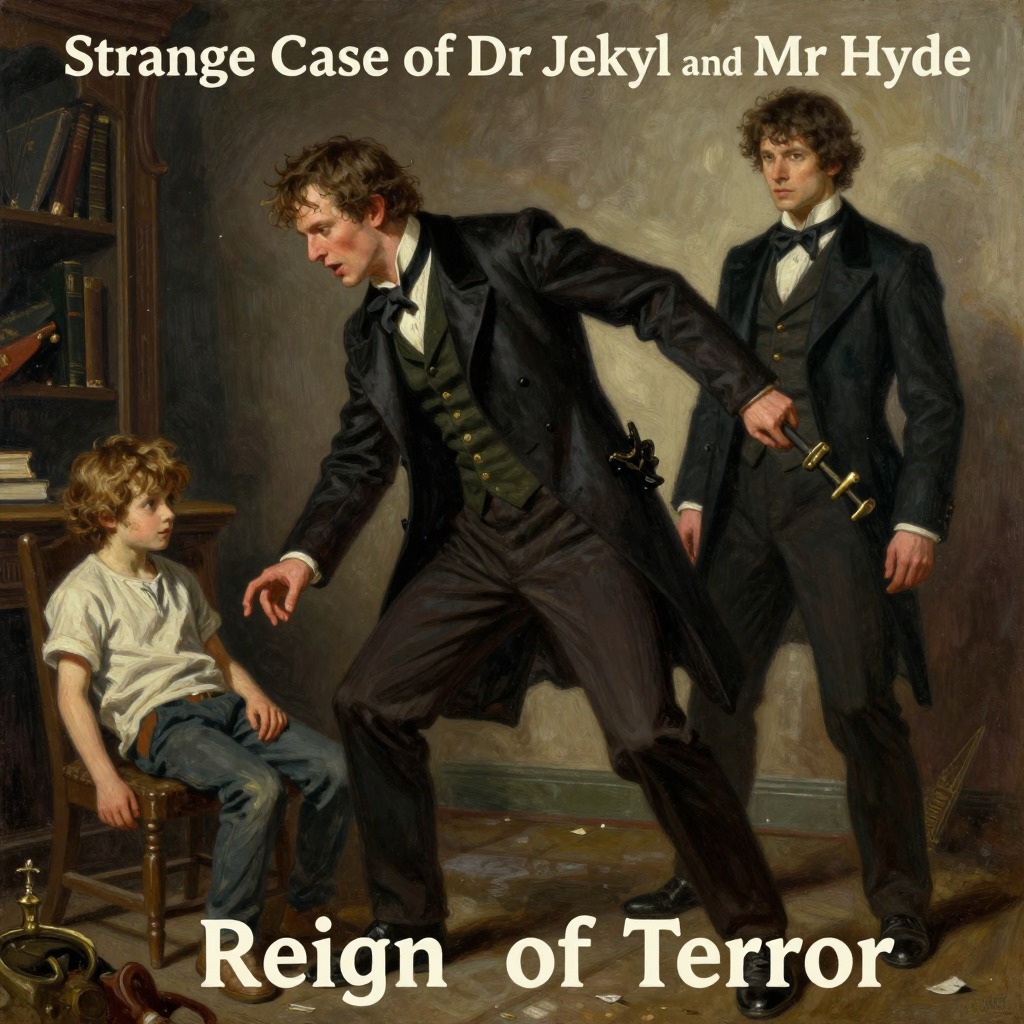
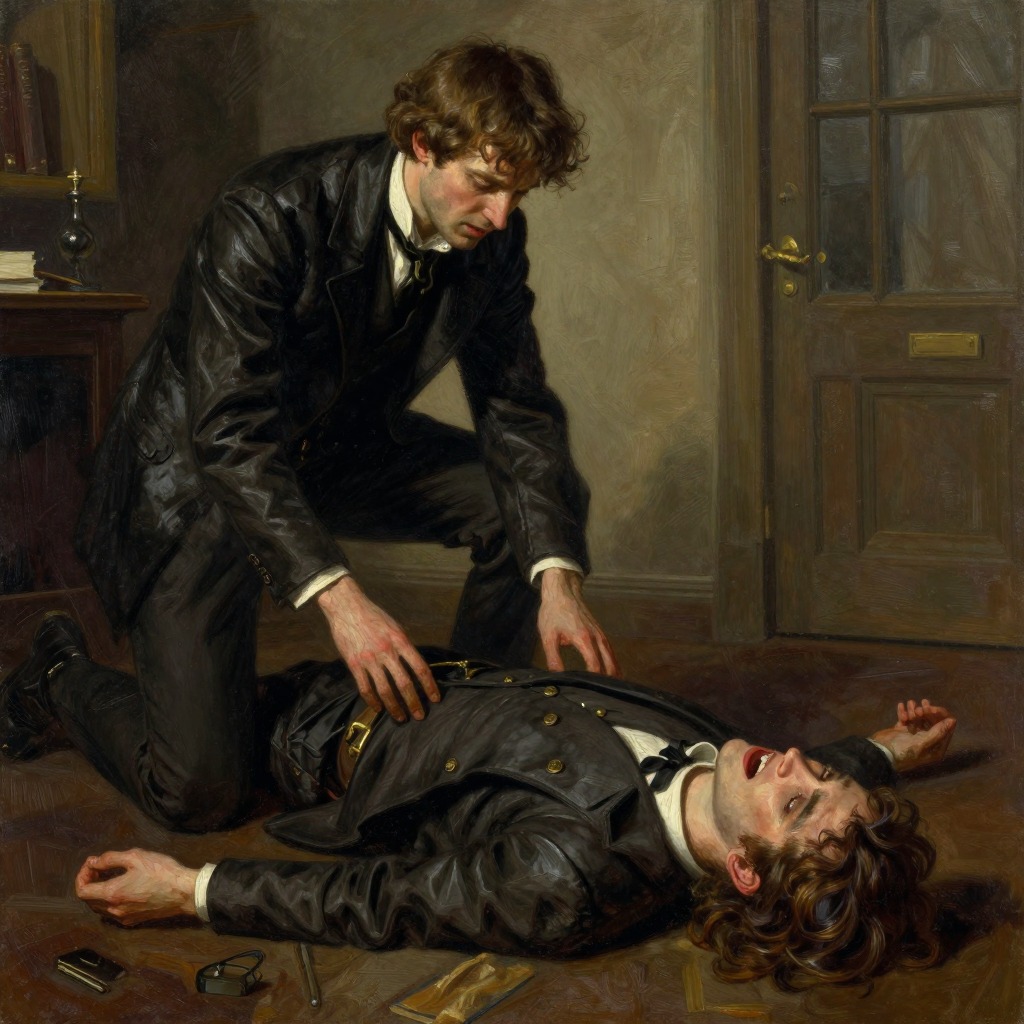
The murder takes place under a full moon, in a lane brilliantly lit and visible from the window of a maid-servant's room. She observes an "aged beautiful gentleman with white hair"—Sir Danvers Carew—approach and politely address a very small man. The maid recognizes the smaller man as Mr. Hyde, a visitor to her master's house for whom she had already conceived a dislike. Hyde, who has a heavy cane in his hand, answers not a word but listens with "ill-contained impatience." Suddenly, he breaks out in a "great flame of anger," stamping his foot and brandishing the cane like a madman. When the old gentleman steps back, surprised and hurt, Hyde "broke out of all bounds and clubbed him to the earth." He then, with "ape-like fury," tramples his victim underfoot and rains down a storm of blows, shattering bones audibly and causing the body to jump on the roadway. The maid faints from the horror.
The Aftermath and Investigation
The maid regains consciousness at two o'clock and calls the police, but the murderer is long gone. The victim's body lies in the lane, incredibly mangled. The heavy, rare-wood cane used in the attack has broken in the middle under the stress of the cruelty; one splintered half is found in the gutter, the other presumably carried away by the murderer. A purse and a gold watch are found on the victim, but no identifying cards or papers—only a sealed, stamped envelope bearing the name and address of Mr. Utterson. This envelope is brought to the lawyer the next morning. Utterson immediately identifies the body as that of Sir Danvers Carew, a client of his. When shown the broken stick, he recognizes it as one he himself had presented many years before to Henry Jekyll. This discovery, combined with the maid's description of a "particularly small and particularly wicked-looking" assailant, confirms the murderer's identity as Edward Hyde.
The Manhunt and Hyde's Disappearance
Utterson leads the police to Hyde's house in the dismal Soho district, a dingy street of gin palaces and cheap eating houses. The house is opened by an "ivory-faced and silvery-haired old woman" with an evil face smoothed by hypocrisy. She reports that Hyde has not been seen for nearly two months until the previous night, when he came in very late and left again in less than an hour. Inside, the rooms are furnished with luxury and good taste, but they bear every mark of a hurried ransacking: clothes lie on the floor with pockets inside out, drawers stand open, and a pile of grey ashes on the hearth suggests many papers have been burned. From the embers, Inspector Newcomen disinters the butt end of a green cheque book, and the other half of the broken stick is found behind the door. A visit to the bank reveals several thousand pounds lying to the murderer's credit. Despite these clues, Hyde has vanished completely. He is "simply blotted out" from the ken of the police, as though he had never existed. His past is unearthed—tales of cruelty, a vile life, strange associates—but of his present whereabouts, not a whisper remains. The murder of Sir Danvers Carew thus becomes the event that makes Hyde a hunted fugitive, a "common quarry of mankind," and sets the stage for the final, desperate acts of the story.